
By: Darryl Reilly
“No visitors after 10:00!” hollers an angry unseen Chicago neighbor while banging on a cluttered-apartment door; this is the first of several contentious interactions over noisiness in the spellbinding solo performance piece Bughouse. There are no visitors in the dwelling, the old man who lives there is vocalizing as he acts out the fantastical stories he bangs away at on a typewriter.
Illinois-born Henry Darger (1892-1973) is considered a premier outsider artist and an initially unpublished novelist and memoirist. Months before his death, the ailing Darger moved from his long-time residence into a nursing home. His landlord discovered several epic novels, an autobiography, and a trove of watercolor paintings all done by Darger. His life’s work was appraised as of artistic value. This was remarkable as the obscure Darger lived a harrowing and poverty-stricken existence.
His mother died during his childhood after giving birth to a girl who was put up for adoption; Darger was forever haunted by never knowing his sister’s whereabouts. His disabled father was unable to care for him and placed him in a Catholic orphanage. He was too much for the nuns and the other charges and was sent to a mental facility. After several failed escape attempts he succeeded and made his way to Chicago. For decades he eked out a living at times as a janitor, dishwasher, and kitchen worker. In the evenings he wrote and painted.

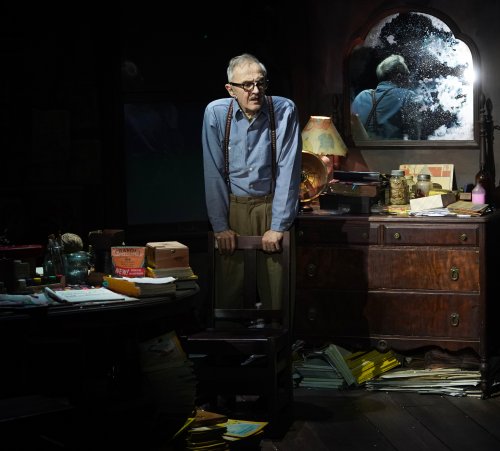
Legendary performance artist John Kelly is entrancing as Darger. With his expressive countertenor voice, luminous stage presence, and lithe physicality, Kelly commands for an enrapturing hour. Darger’s painful life journey and wry observations are vividly enacted by Kelly through impish drollery and aching poignancy.
Bughouse is conceived by renowned theater maker Martha Clarke, and the script is a shrewd and stage worthy adaptation of Darger’s writings by Pulitzer Prize-winning playwright Beth Henley.
Ms. Clarke’s supreme direction is of spatial precision, focused movement, and arresting painterly imagery. These qualities are enforced by high-caliber stagecraft.
Darger’s ramshackle two-room fortress of solitude is stupendously recreated by production designer Neil Patel’s finely detailed old-time underclass apartment. Faye Armon-Troncoso’s authentic set decoration and props are integral to the visual sense of gritty realism. Lighting designer Christopher Akerlind’s mostly dim hues and occasional bright flashes accentuate the piece’s tones and contain fantasy flourishes. Arthur Solari’s forceful sound design renders long ago classic songs, incidental music, and effects with bracing clarity. Costume designer Donna Zakowska vintage working class-style attire for Darger is perfection.
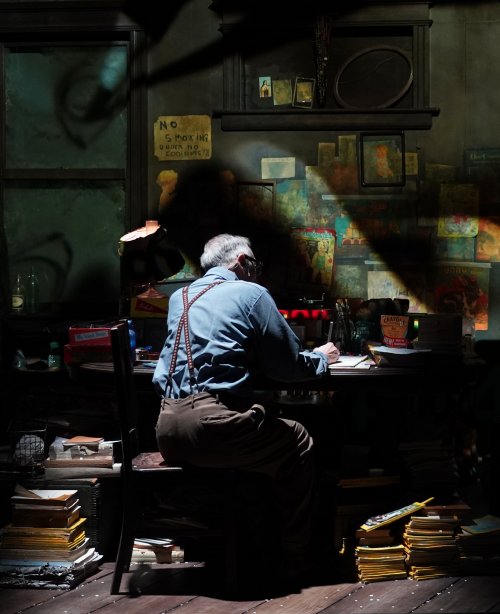
The unison of John Narun’s projection design, Fred Murphy’s cinematography, and Ruth Lingford’s animation, all fulfill Clarke’s shimmering cerebral vision of taking us into Darger’s head with their superior contributions. There are striking views of birds outside the residence’s windows and lovely animated dramatizations of Darger’s grandiose tales. It is like experiencing The Lord of the Rings as if it took place in a hovel.
Darger’s 15,000 plus page novel The Story of the Vivian Girls in What is Known as the Realms of the Unreal, of the Glandeco-Angelinian War Storm Caused by the Child Slave Rebellion is a battle chronicle led by a heroic girl. She is based on Darger’s imaginary takes on his never met sister and a real-life murdered child.
Ultimately, Bughouse is a ravishing, resonant, and uplifting theatrical tribute to Henry Darger and to the spirits of all the downtrodden “outsider” artists who quietly and single-mindedly persevere despite their lack of public recognition from the establishment.
Bughouse (through April 5, 2026)
Vineyard Theatre, 108 East 15th Street, in Manhattan
For tickets, visit www.vineyardtheatre.org
Running time: 60 minutes with no intermission