
By: Darryl Reilly
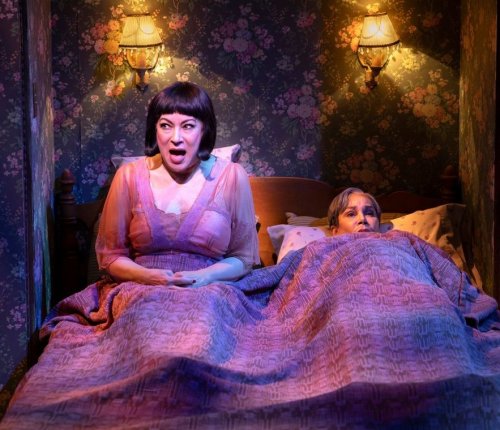
Jennifer Tilly hilariously prattles on and on with accumulating emotional force; her glorious turn is reminiscent of an enactment of Molly Bloom’s soliloquy in James Joyce’s Ulysses. It occurs during an early portion of this haunting revival of Pulitzer Prize-winning playwright Elmer Rice’s (1892-1967) 1923 postmodern absurdist classic The Adding Machine. “I’ve attempted to provide clarity for a modern audience while working to maintain the original’s style, tone, and time period” writes dramatist Thomas Bradshaw of his revisions in the show’s program notes.
The beaming and animated Ms. Tilly employs her expressive voice for tremendous comedic and dramatic effect while reciting a litany of grievances and disappointments as she lays in bed next to her silent long-married husband. Tilly has a black Louise Brooks-style bob, and the scene is rendered in the optic manner of Edward Hopper; despair abounds. Tilly plays Mrs. Zero, and many characters are referred to by numerical surnames. They are all just numbers to the rulers of the waste land they exist in.
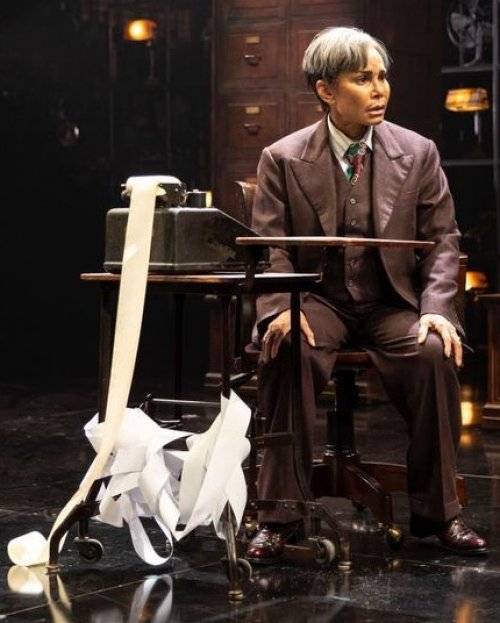
Mr. Zero is incredibly portrayed by Daphne Rubin-Vega. Ms. Rubin-Vega sports short graying hair, wears 1920’s-style men’s attire, and speaks in an old-time New York City accent not heard since The Bowery Boys. Rubin-Vega’s galvinizing central performance breathtakingly veers from comic to tragic.
After 25 years of working as an accountant for a major urban department store while never missing a day, Mr. Zero is fired by his jovial boss. Zero’s job is to be taken over by a state of the art adding machine which will cheaply perform his tasks with rapid efficiency. “What am I going to do? I’m too old to take up something new.” The Adding Machine’s second act is set in an eerie afterlife following Zero and his long-suffering female co-worker’s despondent actions.

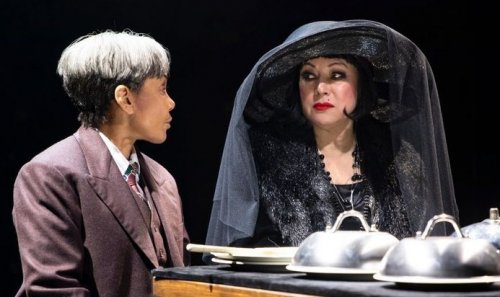
The boss and “Everyone Else” are dazzlingly performed by Michael Cyril Creighton. The physically imposing Mr. Creighton’s distinctive vocal tones and twinkling stage presence enable his precise male and female mini characterizations; his facial expressions and exquisite gestures are priceless.. Besides his gladhanding supervisor, there is his queasy take on a religious fanatic who slit his mother’s throat while carving a leg of lamb, and a gallery of high society types at an impeccably staged dinner party.

With her throaty speech pattern and passionate mien, the alluring Sarita Choudhury offers an aching portrait of one of the downtrodden masses as Daisy, Zero’s unmarried workmate who lives with her mother. Ms. Choudhury’s flat recitation of sums of money for Zero to tally up, interspersed with fanciful observations and rattling off movie titles simply convey their lives of quiet desperation. Choudhury and Rubin-Vega later are entrancing dancing together to Radiohead’s “Creep.”

Director Scott Elliott’s bracing physical staging is of picturesque focus, intense pacing, and implementing inspired stagecraft to achieve an otherworldly dimension conveying expressionism.
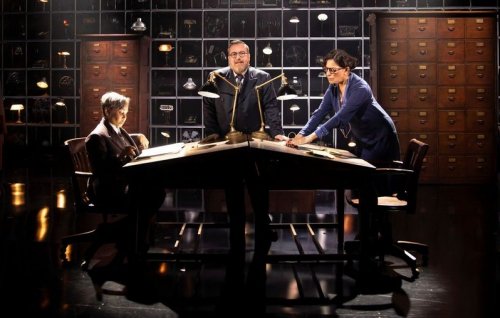
Vintage-type wooden filing cabinets and office furniture are the hallmarks of Derek McLane’s arresting and suitably oppressive scenic design, though there are floral bursts. Lighting designer Jeff Croiter’s moody dim hues are an ideal visual accompaniment. Stan Mathabane’s atmospheric sound design of bygone musical snippets and ominous effects are crisply realized. Costume designer Catherine Zuber’s grand period-style garments range from lavish to drab everyday wear. Tom Watson’s fabulous hair and wig design further accentuate the characters’ appearances.
The Adding Machine opened on Broadway on March 19, 1923, running for 72 performances. There was an Off-Broadway revival in 1956, a 1969 film adaptation featuring Phyllis Diller as Mrs. Zero, and a 2007 musicalization. It remains a fascinating and powerful curio of The Lost Generation. “…we’ve kept much of Elmer Rice’s original language intact, both the prosaic and odious. I love this 100-year-old play, and its critique of society is as deeply resonant for our time as it was when it was first produced” states Bradshaw of his revised version.
This thrilling incarnation of The Adding Machine is simultaneously wrenching and exhilarating. It is presented by The New Group and is its first production at their new Manhattan permanent space, The Theater at St. Clement’s.
The Adding Machine (through May 17, 2026)
The New Group
The Theater at St. Clement’s, 423 West 46th Street, in Manhattan
For tickets, www.thenewgroup.org
Running time: two hours and 15 minutes including one intermission